Technical Articles
Precast Yard Storage: Check the Support Plan Before Changing Dunnage
Organize precast yard checks around approved support locations, stack alignment, ground condition and release records without inventing universal dunnage rules.
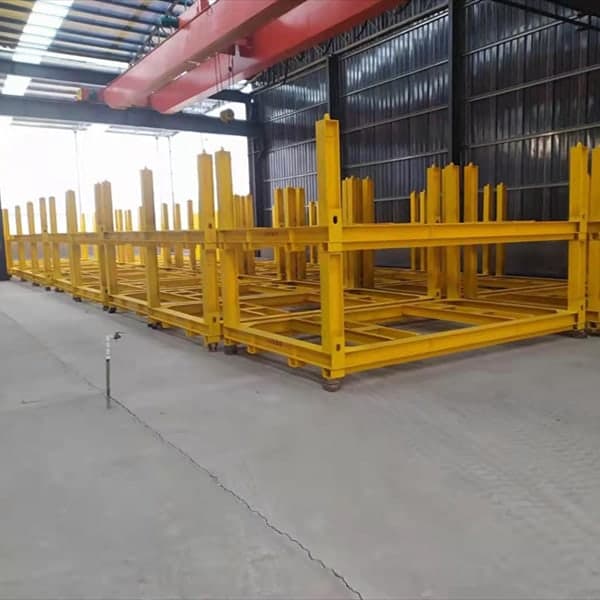
In its December 18, 2023 Questions from the Field column, NPCA answered a producer's question about storing hog slats without cracking them. The response addressed the ground, alignment of supports through stacked layers and placement of dunnage along the product. It is a useful starting point for a yard review, but it is not a support drawing for every precast element.
For a buyer or plant team investigating damage found during storage, the first decision is whether the actual arrangement matches an approved plan for those pieces. Record the arrangement before assigning a cause or proposing new support positions. Keep lifting, restacking, stack-height changes and crack disposition with the responsible engineer and authorized plant team.
This guide concerns stationary yard inventory: what to check, what to record and what needs a written decision before dispatch.
Start with the piece and its approved storage arrangement
Create a storage record tied to the piece mark and drawing revision. Attach the approved support locations, orientation, dunnage specification and permitted stacking arrangement. Ask the precaster to identify which document governs storage if the shop drawing shows only the finished installation.
Keep these questions explicit:
- Does the detail cover this product geometry and orientation?
- Does it cover a single piece or the proposed stack?
- Are the support marks visible and traceable to the drawing?
- Who approves a different arrangement if the designated bay cannot accommodate it?
Do not let an unmarked piece acquire a storage detail by copying the neighboring stack. Record missing information as a question for the person responsible for the plan. Request an approved interim arrangement when necessary; this checklist does not authorize moving a suspect stack.
Treat published spacing examples as scoped examples
The NPCA hog-slat answer discusses approximately one-fifth of the length from each edge for a uniformly loaded slab. It also notes that other loading may need additional analysis. Avoid transferring that example to a prestressed beam, an element with openings or another product without its designer's confirmation.
TxDOT's 2014 Item 425, section 3.1, illustrates a different specification context. It addresses support near beam ends, includes an approval exception for cantilever beams and identifies solid end-block support for box beams and U-beams. These are provisions for the members within that specification, not a general yard spacing rule.
TxDOT subsequently introduced its 2024 specification series. Ask for the edition, amendments and drawings adopted for the actual order. Use published examples to identify questions for the designer, not to resolve a disagreement between drawings by choosing whichever spacing is convenient.
Record the ground and support arrangement together
The NPCA column connects uneven ground and offset dunnage with stresses in stored products. During an authorized yard inspection, photograph the ground, base supports and stack together so the reviewer can understand the arrangement. Add a sketch where photographs hide the rear supports.
Record visible puddles, ruts, leaning supports, gaps and changes since the previous inspection. Distinguish an observed gap from an inferred loss of support. Where safe access does not permit a measurement, identify the inaccessible area rather than estimating it.
For each tier, record the support positions relative to those below. The FHWA report on partial-depth precast deck panels, printed pages 67–68, discusses vertically aligned intermediate dunnage and product-specific support arrangements. Its discussion also includes different intermediate support configurations. It does not establish that every precast product needs an identical full-width strip at every tier.
Ask the engineer or precaster to compare the observed alignment, contact areas and support material with the approved arrangement. Leave capacity, stability and the acceptability of any mismatch for that review.
Turn a yard observation into an assigned decision
Use a short register to keep evidence and decisions connected. The examples below are recordkeeping prompts, not diagnoses or instructions for correcting a loaded stack.
| Observation | Evidence to attach | Decision requested | Reviewer |
|---|---|---|---|
| Support mark missing or inconsistent | Piece mark, drawing revision and support photographs | Confirm the governing storage detail | Precaster and responsible engineer |
| Supports appear offset between tiers | Stack sketch showing each support line and accessible measurements | Assess the arrangement and authorize any change | Responsible engineer and yard lead |
| Ground condition has changed | Dated photographs, inspection history and bay location | Decide whether further assessment or site controls are needed | Yard lead and responsible engineer |
| Contact material differs from the plan | Material identification, dimensions and visible condition | Confirm compatibility and any replacement proposal | Precaster, manufacturer and engineer |
| Crack or edge damage found before dispatch | Piece-specific damage map and earlier inspection records | Issue a written disposition and release conditions | Plant QC and approving authority |
Assign one person to obtain each response. Keep the observation open until the requested decision and any required follow-up evidence are attached.
Maintain inspection and release records
The NPCA plant QC manual, 17th edition, dated February 1, 2024, addresses storage and shipment in section 4.8. It includes daily inspection of the yard and stored products, attention to bearing and stacking arrangements, and separation of rejected stock. This is a dated reference: NPCA identifies the 19th edition, effective February 2, 2026, as its latest manual. Confirm the requirements that apply to the plant rather than presenting the older edition as current certification rules.
For the order under review, request inspection records that connect each relevant observation to a piece or stack. Include dates, the inspector, photographs, any approved change and the resulting disposition. Preserve earlier records when a stack is rearranged so the condition history remains understandable.
Before dispatch, ask QC to reconcile open observations with the release decision. A repaired surface or a new support arrangement should not silently close a question about the original damage. Request the applicable repair approval and inspection evidence where repairs have been performed.
Prepare a focused question for review
Assemble the approved storage detail, piece list, stack sketch, photographs, inspection history and unresolved decisions. State whether the question concerns missing support instructions, a changed yard condition, a proposed rearrangement or damage found before shipping. Separate what was observed from what someone believes caused it.
For help organizing that question, contact the PRECAST.WORLD technical desk. Storage design, safe handling, repair acceptance and dispatch release remain with the responsible project and plant authorities.