Factory Setup
How to Start a Precast Concrete Factory
A practical starting framework for product mix, capacity, land, utilities, equipment scope and production evidence.
Technical summary
Start with product selection and target capacity, then plan land, building, cranes, batching, molds, curing, lab control, staffing and trial production as one system.
Field notes
How to Start a Precast Concrete Factory operating variables
Start with product selection and target capacity, then plan land, building, cranes, batching, molds, curing, lab control, staffing and trial production as one system.
Parameters to verify
- Choose product families before choosing machinery.
- Define small, medium or automated plant assumptions.
- Plan land, factory hall, cranes, batching, curing, storage and shipping together.
- Include laboratory, staff training and trial production in the first phase.
Records and inputs
- Land drawing
- Target products
- Daily output
- Utility availability
Failure modes to watch
- Product demand is not verified.
- Crane and storage planning are weak.
- Curing method is not matched to cycle time.
Visual workflow
Factory flow, not a machine list
Generated workflow composite for explaining factory zones. It is not a supplier photo; use it to read the process sequence and interface points.
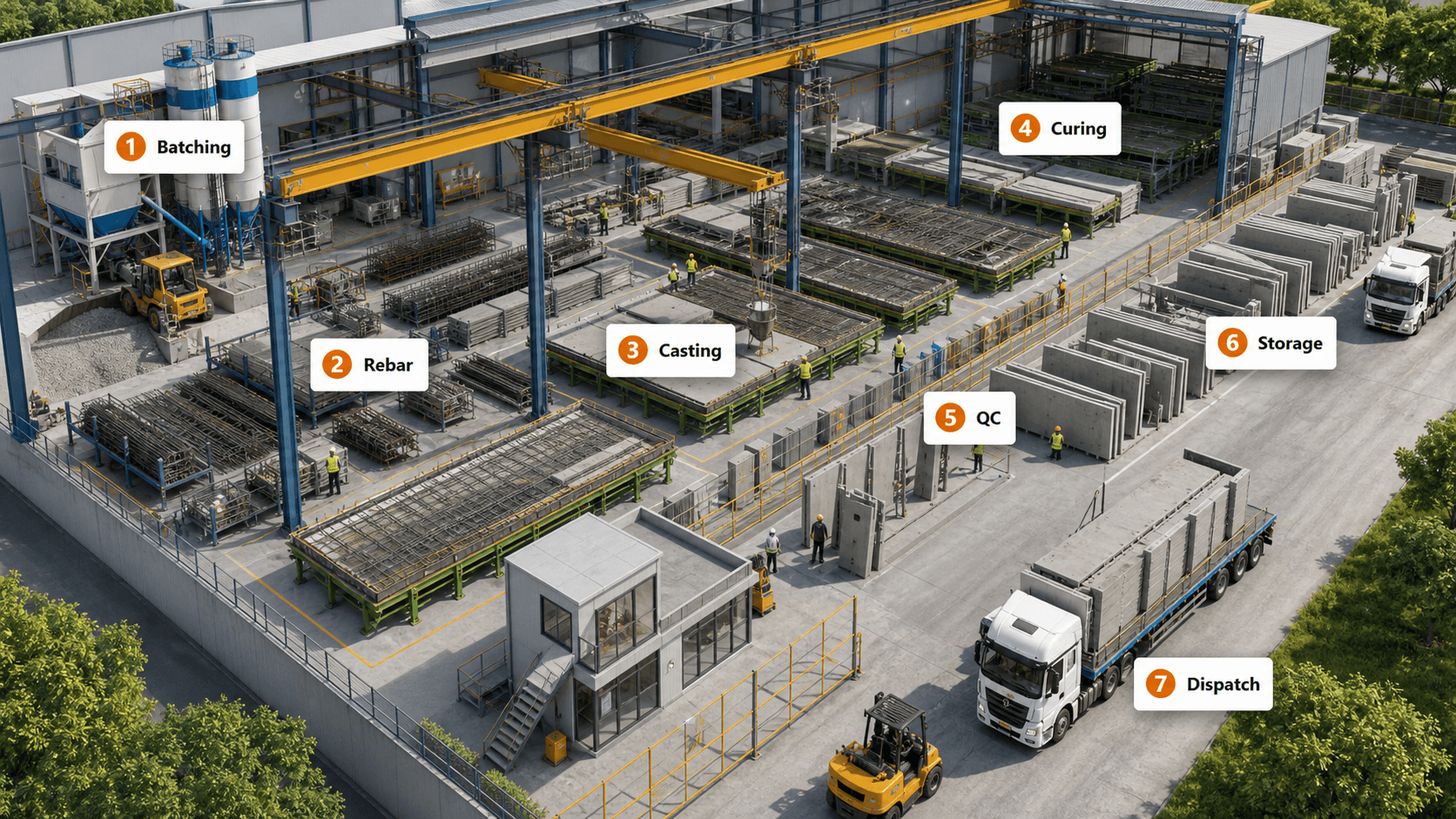
Concrete supply position affects travel distance, distributor route, mixer backup and washout planning.
Cage and mesh preparation must feed molds before casting; late reinforcement becomes the hidden bottleneck.
Tables, molds, embedded parts, concrete delivery and vibration decide the real cycle, not a single machine speed.
Curing area and temperature control set demolding rhythm and early-strength reliability.
Inspection needs space, lighting, measuring tools and records before elements enter storage.
Rack layout, support points, repair access and truck loading sequence determine damage risk.
Finished-element logistics links yard planning, road access, delivery batches and site unloading method.
Production context
Starting a precast factory is less about listing machines and more about designing a production system around products, capacity, workforce and local market demand.
Where this applies
- New plant planning
- Plant relocation
- First precast investment review
- Early equipment comparison
Engineering variables
- Choose product families before choosing machinery.
- Define small, medium or automated plant assumptions.
- Plan land, factory hall, cranes, batching, curing, storage and shipping together.
- Include laboratory, staff training and trial production in the first phase.
System interfaces
- Product mix sets the factory type before equipment names matter.
- Casting, curing, demolding, QC and storage must release elements at the same rhythm.
- Crane coverage and yard route often decide daily output more than machine nameplate capacity.
- Trial production should prove drawings, molds, mix design, lifting and inspection records together.
Production evidence checklist
| Production variable | Why it matters in production | Records or evidence to inspect | Interface risk |
|---|---|---|---|
| Land drawing | Sets building span, casting hall length, crane runway, yard reserve, truck turning radius and future expansion edge. | Dimensioned plot plan, existing buildings, road access, power/water points, drainage and height restrictions. | A line concept can look efficient on paper while storage, truck access or crane coverage fails on site. |
| Target products | Drives mold type, casting orientation, reinforcement workflow, curing method, lifting points and storage racks. | Product family list with dimensions, weight range, reinforcement level, finish requirement and project drawings. | Wall panels, hollow core slabs, pipes, piles and poles create different factories; mixing them without phases causes layout conflict. |
| Daily output | Converts sales target into tables, molds, beds, curing slots, crane cycles, labor stations and yard occupancy. | Pieces/day or m2/day by product, shift hours, demolding age, expected rejection/repair allowance and delivery batches. | Nominal machine capacity is meaningless if curing, demolding, QC or storage cannot release elements at the same rhythm. |
| Utility availability | Constrains batching, steam or hot-water curing, air tools, welding, cranes, compressors, pumps and lab equipment. | Power capacity, voltage, water supply, boiler/steam plan, compressed air, wastewater route and backup assumptions. | Underpowered utilities turn commissioning into local construction work rather than production startup. |
| Labor assumptions | Defines automation level, table count, rebar preparation method, QC staffing, maintenance coverage and training load. | Shift pattern, operator skill level, maintenance team, welding/rebar crew availability and supervision structure. | High automation still needs disciplined maintenance and data entry; manual plants still need enough skilled station leaders. |
| Local standards | Controls concrete class, tolerances, testing frequency, reinforcement detailing, lifting rules and project approval documents. | Project specification, applicable code, client approval checklist, required certificates and inspection hold points. | A factory can physically produce an element that still cannot pass local project approval. |
Technical references
Original sources and related manuals
Open the governing standard record, original process source or related product manual for the underlying scope and terminology.
Use the machine groups and station names to read how pallet movement, turning, storage and plant control connect.
Open process referenceVollert Precast SolutionsPallet circulation system for walls and floorsSpecific process reference for casing pallets, station-to-station circulation, shuttering, concrete spreading, turning, loading and lifting.
Open process referenceVollert Precast SolutionsProduction control systemSpecific process reference for production sequencing, pallet assignment, circulation visualization, subsystem control and fault records.
Open process referenceWeiler GmbHPrecast plant, batching and concrete transport systemsOfficial manufacturer overview for batching, mixer, concrete delivery, prestressed production and plant-handling interfaces.
Open process referenceApollo Afinitas TechnologiesConcrete pipe, manhole and box-culvert plant equipmentOfficial manufacturer overview for pipe and infrastructure product lines, molds, cage welding, curing and handling equipment.
Open process referenceWeak assumptions seen in projects
- Approving equipment before confirming product mix.
- Underestimating storage yard space.
- Ignoring molds, lifting gear and lab equipment in the first budget.
Inspection and acceptance points
- Product demand is not verified.
- Crane and storage planning are weak.
- Curing method is not matched to cycle time.
- Quality lab is missing from the plan.
FAQ
What is the first decision to make for how to start a precast concrete factory?
Start with product type, target capacity and local requirements. These inputs shape equipment, mold, material and quality-control choices.
What information should be prepared before speaking with suppliers?
Prepare drawings, target output, local standards, installation limits, available utilities, budget range and the questions you need answered.
Need to frame the technical context?
Send product type, capacity target, standards, drawings, photos or quality issues. PRECAST.WORLD will turn them into clearer technical notes for the next discussion.